Showing posts with label Apologetics. Show all posts

Sunday, June 10, 2012

What Is "Truth"? My Reply to a Seeker

Last year, my little netbook (which was my primary computer at the time) suffered a catastrophic melt-down of the type that for a time basically left me without my own personal computer. All my files and projects became inaccessible and were, for the most part, gone for good (Wah!). I have since then learned the error of my ways and am backing up all my important data.

Recently, I ran across a draft of a blog entry that I was composing at the time my netbook crashed and that I had presumed was gone forever. It was a reworking of an e-mail that I sent in response to a dear relative several years ago who was considering foregoing the Catholic Church for the religion of a friend (ironically, the relative was also experiencing computer problems at that time). We exchanged a few e-mails on the subject, and the question came up, "How can I know the truth?" Below is my answer (slightly edited) which I thought I'd share here:
---------------------------------------------------------------------------------

Well, I'm afraid I can’t help you with your Windows Explorer-- I’'ll defer to others on that. But you also asked the question: how can a person know the truth?

Well, I hope you really want to know, because one of the reasons it took me so long to answer is that I wanted to think it over and give you MY best answer and not just send you another article. So here goes:

How do you know the truth? That’s a good question and one that almost everyone asks themselves sooner or later. Socrates said that “the unexamined life is not worth living.” Confucius tells us that “the aim of the superior man is truth.”

In the Bible, Jesus tells us if we listen to him “"we are truly [his] disciples, and you will know the truth, and the truth will make you free." (John 8:31-32), and that "I am the way, and the truth, and the life; no one comes to the Father, but by me.” (John 14:6). The Catechism of the Catholic Church (which I very highly recommend you have a copy of) says: “Man [and of course this includes women] tends by nature toward the truth. He is obliged to honor and bear witness to it: "It is in accordance with their dignity that all men, because they are persons . . . are both impelled by their nature and bound by a moral obligation to seek the truth, especially religious truth. They are also bound to adhere to the truth once they come to know it and direct their whole lives in accordance with the demands of truth." (CCC 2467). 

Many of the really important things we come to know or to believe are usually a result of a serious search, examination and reflection. A lot of intangibles like love and acceptance, responsibility and commitment, we learn by experience. These things are real, but are personal and hard to really explain. Truth, on the other hand is actually more tangible; it is something that can be identified and recognized when seen, and can be explained and shared with someone else. 

The first thing to do is to pray. This is also the last thing, but a lot of people tend to look on prayer as only a tactic of last resort, when in fact what makes more sense is that you want to invoke God's assistance and guidance before (and during) your search for Truth as well. Even if you aren't at the place yet where you even believe there's a God who hears and answers prayer, a simple prayer such as "God, I don't know if you are even real, but if you are please guide me to you and to the Truth" is a perfectly good one.

At this point you can start asking questions-- serious questions with the intent of really wanting to know the answer. We could start with a dictionary definition of truth: “Conformity to fact or actuality; fidelity to an original or standard; reality, actuality; a statement proven to be or accepted as true; sincerity, integrity.” By this it follows that, whatever the opposite of truth is, is not the truth. Based on this, we can further say what the truth is not. Truth is not

· Our feelings or emotions or personal preference 
· Whatever seems true for one situation and not another 
· Whatever seems true for one person (culture, group, etc.) and not another 
· Whatever seems true for another time and place, but not another 

In other words, Truth is not subjective, nor is it relative. Authentic Truth cannot be one thing for me and another for you. Either something is true, or it is not.

Is what someone is telling you the Truth-- really the Truth? Maybe, maybe not. What is important is to hold what you hear to an objective (true) standard to which it can be measured. 

For example, let’s now briefly take up the issue you had before you recently: is someone telling you their church believes one thing, but you are told by someone else that is not the case? Both statements cannot be true, so in that case you must do one of two things: believe the person or source that you trust the most, or research the issue yourself. 

If you decide to research the issue, you also must weigh the reliability of the materials you use to find your answers. If you take the word of a trusted (not merely likable) person or source over another, you must decide which source or person is more reliable. In this case we are discussing, the question would be: is what the Mormons say is true or is what the Catholic Church says true? Who is more reliable and more likely to possess the Truth? 

This is how I see it, and you can take it for what it’s worth. It is a fact of history that the Catholic Church was founded by Christ himself and that the Scriptures clearly teach that he gave his own authority and the guidance of the Holy Spirit to this same Church to teach in his name until he comes again (I think I have good historical, logical, biblical and experiential reasons for believing this and if you are interested I can send you or direct you towards some further information). As a result, I believe the Church is an entirely reliable source and guide for Truth and has been such for almost 2000 years. On the other hand, it is a fact of history that the Mormon religion was founded less that 200 years ago by a man with a questionable background and motives who introduced teachings that NO Christian has ever believed in the 2000 years of Christian history (again, I have material on this if you are interested). As you can see, this approach is based on reality and reliability. As applied to the overall subject of Truth, this is just one issue, but you get the idea. 

When Pontius Pilate asked Jesus, "What is truth", he didn't really want to know, but was simply going through the motions of being a sophisticated seeker of Truth. If you really want to know what the Truth is, you have to not just ask, but sincerely search for that Truth using your head as well as your heart. And it’s worth the hard work you put into it because it is always better to be in the Truth than not. The Truth makes a person more confident and less anxious and, no matter what their condition in life is, it fills their life with freedom and real joy. This is what I have found in my own life, and it is what I hope for you and everyone else. 

Saturday, May 29, 2010

Quick Question About "The Da Vinci Code"

I suscribe to a service called "Quick Questions" that sends out a daily e-mail answering questions about the Catholic Faith. Todays question addresses the topic of The Da Vinci Code, the highly controversial-- and still, widely read-- novel by Dan Brown. I thought the staff apologist that answered this question did a good job in addressing the main issues of why Catholics (and anyone interested in truth) have problems with Browns book-- and, by extension, any work or literary or cinematic fiction that distort or play loose with serious historical facts and religious truths:

Q: “I have just read Catholic Answers' report on the novel The Da Vinci Code by Dan Brown. I have to say that the Church seems very flustered about the book. Surely the Church has nothing to fear from a work of fiction, no matter what the view of the author.”

A: Actually, the Church as an institution has had no comment, one way or the other, on The Da Vinci Code. The book has not been placed by the Vatican on any "forbidden books" list nor have any "official" sanctions been placed on it. Those who are concerned are faithful Catholics, clerical and lay, who have seen the book confuse Catholics and other Christians about the character of people in the early Church, the relationship of Jesus Christ and Mary Magdalene, and orthodox Christian doctrine.

Although many have claimed that Christians shouldn’t be concerned about the novel because it is fiction, Brown himself has touted the book as the fruit of factual research. He opens the novel with a "Fact Page" that purports to be unvarnished truth. In other words, he wants people to believe that his conclusions in the novel are true.

Even had Brown not advertised his book to reveal hidden "truths" about Christianity, the device of fiction does not grant authors the right to disseminate historical untruths. Analogously, a novel that purported to reveal that the Holocaust never happened and that Adolf Hitler was really a great guy would be (quite properly) discounted by people of good will everywhere as anti-Semitic agitprop. Indeed, in this day and age, such a book would likely never see publication, at least by mainstream publishers. If such a book as that could not be defended with the disclaimer "It’s only a novel!" then other books that spread historical untruths also cannot be defended as "only fiction."

You can subscribe the "Quick Questions" by going to the Catholic Answers website and clicking on the banner that says "Quick Questions E-Letter FREE."

Friday, March 5, 2010

Anti-Catholic Tract Stirs Controversy

Think rank anti-Catholicism has gone the way of the 19th century Know-Nothings? Think again, as a Baptist minister in Tennesee has gotten himself in hot water for distributing the infamously anti-Catholic tract, "The Death Cookie," penned and distributed by the notoriously anti-Catholic (and anti-A Lot of Other Things), Jack Chick. From the report by Fox News:

A Baptist pastor in Tennessee says he now regrets that his church distributed an anti-Catholic leaflet that a local Catholic priest decried as “hate material."

Pastor Jonathan Hatcher, who leads Conner Heights Baptist Church in Pigeon Forge, Tenn., has removed the inflammatory leaflet, “The Death Cookie,” from his congregation. He says he will no longer distribute it.

“Looking back, I don’t think it was the right tract to give out,” Hatcher told FoxNews.com. “I have some others that wouldn’t have been as offensive. But I will continue to spread the gospel — that’s what I’m called by Christ to do. I’m still going to hand out tracts, but not ‘The Death Cookie.’”

The illustrated leaflet, distributed since 1988 by California-based Chick Publications, features an ominous character with a snake around his neck who advises a man that he can control the world by establishing a false religion based upon worshipping a cookie. Upon taking the control of the cookie, the man becomes the "papa" — a reference to the pope.

Jack Chick had a huge presence in California when I was growing up there, and after my adult conversion to the Faith, I ran into his little booklets (including this particular one) in just about every Protestant book store I went into. I wrote one shop to request they stop carrying them, but they never answered back. I complained to another large store, which featured an entire aisle dedicated to the tracts, and they replied "Many of our customers find the tracts helpful so we feel obliged to carry them." I visited the store a few years ago and noted (to my satisfaction) that they no longer seemed to carry them. (On the other hand, I was chatting with a young Baptist minister in his office last month, and when he opened his desk drawer to get something, I saw a neat little stack of Chick tracts in the corner. Sigh.)

These days you normally find them strategically placed (just like Jehovah's Witness materials) in locations --- campus, bar room and truck stop bathrooms; public laundry facilities; telephone booths, etc. --- where they can be picked up by the most vunerable audience, i.e. bored folks looking for something to read, and those largely uneducated in religion and most likely to be swayed by simplistic and emotional arguments.

As noted in the news report, Jack Chick has a long and colorful career as an anti-Catholic. The apologetics organization, Catholic Answers has done a comprehensive special report on this gentleman's "ministry" called "The Nightmare World of Jack T. Chick." You can find it here.

Finally, I would like to give kudos to the priest, Father Jay Flaherty, for opposing this bigotry and well-worn hate literature and for standing up for truth and for the members of his flock. This is just what a good shepherd is supposed to do.


Monday, December 7, 2009

Celebrating, Understanding and Defending the Immaculate Conception

Tuesday, December 8th, is the Feast of the Immaculate Conception, a Holy Day of obligation for Catholics (so if you're Catholic, get thee to your local parish), but at the same time one of the most misunderstood beliefs that are held by Catholics.

This article and this article will help you appreciate and understand the background of this singular privilige granted to Mary, the mother of Jesus (and, since Jesus is God, the Mother of God) --a privilige granted to her not because of Mary's own merits or glory, but because if it's fittingness in relation to her role as Mother of Our Redeemer (like all of the teachings of the Church about Mary, the doctrine says more about the uniqueness and holiness of Jesus than it does about Mary).
.
If, however, you find yourself in the position of having to explain this wonderful Christian truth, here is a helpful article from Catholic Answers. It answers the questions:

1. Why does the Church teach that Mary was immaculately conceived? Her conception is never even mentioned in Scripture.

2. If Mary is sinless, doesn’t that make her equal to God?

3. How could Mary be sinless if in the words of the Magnificat she said that her soul rejoices in God her savior?

4. How can you reconcile Mary’s sinlessness with Paul’s statement that all have sinned and fall short of the glory of God?

5. Didn’t the Church just invent the doctrine 150 years ago?

This article may also be helpful.
To misunderstand a concept is to fear and hate it, but to know the truth often leads one to love it. Be ready when your questioning friends and families are looking for answers and help lead them from fear and hate, to truth and love.

Friday, October 30, 2009

Anti-Catholicism Is the Nation's Other Pastime

By Archbishop Timothy M. Dolan, Archbishop of New York
.
October is the month we relish the high-point of our national pastime, especially when one of our own New York teams is in the World Series!

Sadly, America has another national pastime, this one not pleasant at all: anti-Catholicism.

It is not hyperbole to call prejudice against the Catholic Church a national pastime. Scholars such as Arthur Schlesinger Sr. referred to it as "the deepest bias in the history of the American people," while John Higham described it as "the most luxuriant, tenacious tradition of paranoiac agitation in American history." "The anti-Semitism of the left," is how Paul Viereck reads it, and Professor Philip Jenkins sub-titles his book on the topic "the last acceptable prejudice."


(Read more here.)

Thursday, October 15, 2009

What Must We Do To be Saved?

Readers of this blog who are not Catholic may not know that Catholic Christians not only have Mass on Sunday's, but also have daily Mass, in some places every day of the week. Just like on Sunday, the proclamation of God's Word is made every day during Mass, including two readings from Sacred Scripture, usually one from the Old Testament or New Testament letters, and one from the four Gospels. The first reading from Mass today was from St. Paul's letter to the Romans, Chapter 2, verse 21 through 30. This is such an important reading on so many levels.

On one level, it was the Reformers misunderstanding of this passage (especially verse 28) and similar passages that fueled the Reformation and undergirds much of what Protestant Christians believe today. The main mistaken premise here is that Paul's reference to "works" or "works of the Law" refer to good works in the sense of moral actions, when in fact it has been shown by scholars (Catholic, Jewish and Protestant) that by this term Paul and his contemporaries instead used this term exclusively to refer to the ritual and purity prescriptions of the Torah (the first five books of the Jewish Scriptures). This colors a Christian's entire understanding of Paul's writings and, by extension, what one believes about how one is saved. The Catholic understanding dovetails perfectly with the rest of Scripture, especially James chapter 2 where we are told that "we are not saved by faith alone" and "faith without works is dead."

Anyway, the Navarre Bible commentary on this passage has an excellent summation of official Catholic teaching on salvation as it relates to Romans. Many Protestants will be surprised that they will find much to agree with here, and even that they may be misinformed as to what the Catholic Church believes about salvation and answer the question: "What must I do to be saved?"

What follows is the passage from Romans and then the Navarre Commentary:

From: Romans 3:21-30

Righteousness, a Free Gift through Faith in Christ
--------------------------------------------------

[21] But now the righteousness of God has been manifested apart from law, although the law and the prophets bear witness to it, [22] the righteousness of God through faith in Jesus Christ for all who believe. For there is no distinction [23] since all have sinned and fall short of the glory of God, [24] they are justified by his grace as a gift, through the redemption which is in Christ Jesus, [25] whom God put forward as an expiation by his blood, to be received by faith. This was to show God's righteousness, because in his divine forbearance he had passed over former sins; [26] it was to prove at the present time that he himself is righteous and that he justifies him who has faith in Jesus.

[27] Then what becomes of our boasting? It is excluded. On what principle? On the principle of works? No, but on the principle of faith. [28] For we hold that a man is justified by faith apart from works of law. [29] 0r is God the God of Jews only? Is he not the God of Gentiles also? Yes, of Gentiles also, [30] since God is one; and he will justify the circumcised on the ground of their faith and the uncircumcised through their faith.

*******************************
Commentary:

21-22. The doctrinal richness of this text and of the whole passage (vv. 21-26) is here condensed in a way very typical of St Paul's style. He explains how justification operates: God the Father, the source of all good, by his redemptive decree is the "efficient cause" of our salvation; Jesus Christ, by shedding his blood on the Cross, merits this salvation for us; faith is the instrument by which the Redemption becomes effective in the individual person.

The righteousness of God is the action by which God makes people righteous, or just (cf. St Augustine, "De Spiritu Et Littera", IX, 15). This righteousness was originally proclaimed in the books of the Old Testament--the Law and the Prophets--but it has now been made manifest in Christ and in the Gospel. Salvation does not depend on fulfillment of the Mosaic Law, for that Law is not sufficient to justify anyone: only faith in Jesus Christ can work salvation.

"If anyone says that, without divine grace through Jesus Christ, man can be justified before God by his own works, whether they were done by his natural powers or by the light of the teaching of the Law: let him be anathema" (Council of Trent, "De Iustificatione", can. 1).

It is not the law, then, which saves, but "faith in Jesus Christ". This expression should be interpreted in line with the unanimous and constant teaching of the Church, which is that "faith is the beginning of human salvation", and a person's will must cooperate with faith to prepare the ground for the grace of justification (cf. ibid., chap. 8 and can. 9).

23-26. The Apostle first describes the elements that go to make up themystery of faith (vv. 23-25): all men need to be liberated from sin; God the Father has a redemptive plan, which is carried out by the atoning and bloody sacrifice of Christ's death; faith is a necessary condition for sharing in the Redemption wrought by Christ; the sacrifice of the Cross is part and parcel of the History of Salvation: before the Incarnation of the Word, God patiently put up with men's sins; in the fullness of time he chose--through Christ's sacrifice--to require full satisfaction for those sins so that men might be enabled to become truly righteous in God's eyes and God's perfections become more manifest.

"The Cross of Christ, on which the Son, consubstantial with the Father,renders full justice to God, is also a radical revelation of mercy, that is, of the love that goes against what constitutes the very root of evil in the history of man--against sin and death" (John Paul II, "Dives In Misericordia", 8).

23. "Fall short of the glory of God": this shows the position man is in when he is in a state of sin. Because he has not the life of grace in him, he is not properly orientated towards his supernatural end, is deprived of the right to heaven that sanctifying grace confers, and consequently does not have these divine perfections which supernatural life gives him.

24. All have been justified, that is, all have been made "righteous" (cf. 1 :17). This justification is the result of a gratuitous gift of God which St Paul describes in a way which reinforces his point ("grace", "as a gift"): this identifies the source of the gift as God's loving-kindness and it also shows the new state in which justification places a person so important is this statement--that grace is a gift which God gives without merit on our part--that the Council of Trent, when using this text from St Paul, made a point of explaining what it meant: that is, that nothing which precedes justification (whether it be faith, or morals) merits the grace by which man is justified (cf. Rom 11:16; Council of Trent, "De Iustificatione", chap. 8).

This new kind of life, whose motor is grace, requires free and active cooperation on man's part; by that cooperation a person in the state of grace obtains merit through his actions: "For such is God's goodness to men that he wills that his gifts be our merits, and that he will grant us an eternal reward for what he has given us" ("Indiculus", chap. 9). The fact that grace is a gratuitous gift of God does not mean that man does not have an obligation to respond to it: we are not justified by keeping the Law or by a decision of our free will; however, justification does not happen without our cooperation; grace strengthens our will and helps it freely to keep the Law (cf. St Augustine, "De Spiritu Et Littera", IX, 15).

Justification by grace is attained "through the redemption which is in Jesus Christ". The Council of Trent teaches that when a sinner is justified there is "a passing from the state in which man is born a son of the first Adam, to the state of grace and adoption as sons of God through the second Adam, Jesus Christ our Savior" ("De Iustificatione", chap. 4). This has been made possible because our Lord saved us by giving himself up as our ransom. The Greek word translated as "redemption" refers to the ransom money paid to free a person from slavery. Christ has freed us from the slavery of sin, paying the necessary ransom (cf. Rom 6:23). By sacrificing himself for us, Christ has become our master or owner, who mediates between the Father and the whole human race: "Let us all take refuge in Christ; let us have recourse to God to free us from sin: let us put ourselves up for sale in order to be redeemed by his blood. For the Lord says, 'You were sold for nothing, and you shall be redeemed without money' (Is 52:3); without spending a penny of your inheritance, for I have paid on your behalf. This is what the Lord says: He paid the price, not with silver but with his blood" (St Augustine, "In Ioann. Evang.", 41, 4).

Our very creation means that we belong totally to God the Father andtherefore also to Christ, insofar as he is God, but "as man, he is also for many reasons appropriately called 'Lord'. First, because he is our Redeemer, who delivered us from sin, he deservedly acquired the power by which he truly is and is called our Lord" ("St Pius V Catechism", I, 3, 11).

And so, through the Incarnation, whose climax was Christ's redemptive sacrifice, "God gave human life the dimension that he intended man to have from his first beginning; he has granted that dimension definitively [...] and he has granted it also with the bounty that enables us, in considering the original sin and the whole history of the sins of humanity, and in considering the errors of the human intellect, will and heart, to repeat with amazement the words of the sacred Liturgy: 'O happy fault...which gained us so great a Redeemer!'"(John Paul II, "Redemptor Hominis", 1).

25. The "expiation" was the cover or mercy seat of the Ark, which stood in the center of the Holy of Holies in the Temple (cf. Exod 25:17-22). It was made of beaten gold and had a cherub at either end, each facing the other. It had two functions: one was to act as God's throne (cf. Ps 80:2; 99:1), from which he spoke to Moses during the time of the exodus from Egypt (cf. Num 7:89; Exod 37:6); the other was to entreat God to pardon sin through a rite of expiatory sacrifice on the feast of the Day of Atonement (cf. Lev 16): on that day the High Priest sprinkled the mercy seat with the blood of animals sacrificed as victims, to obtain forgiveness of sins for priest and people.

St Paul asserts that God has established Jesus as the true expiation, of which the mercy seat in the Old Testament was merely a figure.

No angel or man could ever atone for the immense evil that sin is--an offense to the infinite majesty of God. The Blessed Trinity decided "that the Son of God, whose power is infinite, clothed in the weakness of our flesh, should remove the infinite weight of sin and reconcile us to God in his Blood" ("St Pius V Catechism", I, 3, 3).

This expiatory sacrifice, prefigured in the bloody sacrificial rites of the Old Testament (cf. Lev 16:1 ff), was announced by John the Baptist when he pointed to Jesus as the Lamb of God (cf. Jn 1:29 and note); and Jesus himself referred to the sacrifice of the Cross when he said that the Son of man had come "to give his life as a ransom for many" (Mt 20:28).

This sacrifice is renewed daily in the Holy Mass, one of the purposes of which is atonement, as the Liturgy itself states: "Lord, may this sacrifice once offered on the cross to take away the sins of the world now free us from our sins" ("Roman Missal", Feast of the Triumph of the Cross, prayer over the gifts).

26. In the time prior to Christ's coming the sins of mankind remained unatoned for: neither the rites designed by man to placate God's anger, nor those established by God himself in the Old Law, were in any way equal to atoning for the offense offered to God by sin. Therefore, the just of the Old Testament were really justified by virtue of their faith in the future Messiah, a faith which expressed itself in observance of the rites established by God.

During all this period the Lord kept deferring punishment ("passing over former sins"). This time of "God's forbearance" lasted until the messianic era "the present time", that is, the period between the first and second comings of Christ. On the righteousness of God and God as the Justifier of man, see note on Rom 1:17.

27-31. These words are addressed to the same imaginary interlocutor as appeared at the beginning of the chapter. Although he is Lord of all nations, God showed special preference for the people of Israel. Relying on this, the Jews wrongly thought that only they could attain blessedness because only they enjoyed God's favor. This led them to look down on other peoples. After the coming of Christ, they no longer have any basis for this pride: St John Chrysostom explains that it had simply become outdated, superseded (cf. "Hom. On Rom", 7), for God had set up a single way of salvation for all men--the "principle of faith" which the Apostle refers to. This new way means that Jews must forget their ancient pride and become humble, for God has opened the gates of salvation to all mankind.

Consequently, no one--not even the Jew--is justified by works of the Law. What justifies a person is faith: not faith alone, as Luther wrongly argued, but the faith which works through charity (cf. Gal 5:6); faith which is not presumptuous self-confidence in one's own merits, but a firm and ready acceptance of all that God has revealed, faith which moves one to place one's hope in Christ's merits and to repent of one's sins. Therefore it will be "by faith"--not by circumcision--that the Jews will be justified, and it will be "through their faith" that the uncircumcised will attain salvation. From this it might appear as though the Law had been revoked; but that is not the case: faith ratifies the Law gives it its true meaning and raises it to perfection. For, through being a preparation for the Gospel, the Mosaic Law receives from Christ the fullness it was lacking: the precept of charity reveals the meaning which God gave the law but which lay hidden until Christ made it manifest, for "love is the fulfilling of the law" (Rom 13:10). St Paul in a way summarizes all this teaching in v. 28, which is the key statement in the passage.
For more information, see my previous post, How Are We saved?

Sunday, October 4, 2009

Fr. Robert Barron On "The YouTube Heresies"

Here is a two part presentation by Fr. Robert Barron, priest of the Archdiocese of Detroit and founder of The Catholicism Project. In these videos he explains modern impediments to embracing Christianity in general and Catholicism in particular. Part 1 covers 'scientism' (the belief that science explains everything) and 'angelism' (the belief that if the Church were authentic everyone inside the Church would be perfect). Part 2 discusses fundamentalist versus Catholic methods of interpretation of Sacred Scripture and how, in the popular mind, they are conflated.

More videos by Fr. Barron can be found at his website, found here.
(photo above is an icon of St. Irenaeus)

Thursday, July 23, 2009

Facing the Canon

As you may know I am currently teaching a series of classes on Catholic apologetics at my parish. One class topic we explored was on the canon of Scripture, that is, on why the Catholic Bible contains seven more Old Testament books than Protestant Bibles (or, alternately phrased: why are Protestant Bibles smaller?)

The word “canon” comes from a Greek word (that may be derived from a Hebrew word) originally meaning “reed”— it means a standard, or rule. Christians apply the term to the list of inspired books that appear in the Bible. After being defined by the Church in her early centuries, the canon went virtually unchallenged for about 1100 years, that is, until the Reformation.

Someone who attends my class asked me "All this is great information, but when do you ever have an opportunity to use it?" I told her that the opportunities will come when you least expect it, and the knowledge is never wasted.

The following is from an amiable conversation I had earlier this week in a online discussion forum regarding the canon of Scripture. I am in blue and my interlocutor is in red:

First, you don't even know your own history concerning your Church and the Apocrypha or you chose pick out the certain parts and leave out others; they were used by some for devotional purposes and not by others within your own Church, some considered them inspired and others did not within your own Church; but when the reformation came and and challenged the issues of praying to and for the dead, the perpetual virginity and immaculate conception and other challenges were made to the Church; this is when they decided to hastily Canonize 11 of the 14 Apocrypha books. This way anyone who denied the books as inspired and the issues contained within; then the Church pronounced anathema on them.

I'm afraid it is you, my friend, who are ignorant of history. The Council of Trent merely reaffirmed, in the face of heresy, the 73 book canon that had been authoritively affirmed several times before that. To wit:

·Council of Rome, 382 AD, included all protocanonical AND deuterocanonical books (this is the first record we have, incidently, of all 27 New Testament books being affirmed as canonical. Protestants acknowledge this, but deny that same ccouncils authority to affirm the 73 OT books. Go figure.)

·73 book canon ratified by the Councils of Hippo (393 AD) and Carthage (397 AD).

·73 book canon infallibly declared at the Council of Florence (1441)

·73 book canon dogmatically defined by the Council of Trent in 1546.

Furthermore, from the Jewish perspectives the Hebrew canon was closed around 300 BC and did not include any of the extra books.

By then the Church had long been using the Septuagint version of Scripture that included all 73 books. Besides, in what way does 4th century Judaism have the right to definitively define the Christian canon?

The earliest Septuagint did not include the Apocrypha and overtime it was added.

It is true that there were several Septuagint versions with varying canons. What is crucial is that the early Church clearly used the version of the Septuagint containing the canon that contained 46 books, as a careful reading of the New Testament and the Apostolic and other Early Church Fathers will affirm.

At this point, the other party started ignoring my posts and basically kept repeating the same information. But hopefully a seed was planted; if not in this particular person, but in others who may have been viewing the conversation. If nothing else, it was good practice for me. :)

Sunday, July 12, 2009

Who Were The Earliest Christians and What Did they Believe?

The Apostolic, or Early Church Fathers (ECF), were the first Christians that picked up where the New Testament-era Christians left off. The ECF period is roughly considered to span the years from around 100 A.D. to about 700 A.D (the term Apostolic Father is usually given to those who knew or who are thought to have known and been taught by the Apostles themselves. St. Polycarp, for example). The study of their writings is called patristics. As Joe Gallegos on his Corunum Apologetics website explains:

Who are these guys(and gals) called The Church Fathers?The Church Fathers is a titled bestowed on men (and some women such as Egeria of Spain fl AD 448) in the ancient Church that are united by four trademarks: (1) a rigid orthodoxy in doctrine, (2) an exemplary holy life, (3) approval in the Church, and (4) antiquity. Today, some ecclesiastical writers are bestowed this title who have partially fulfilled these marks( e.g. Tertullian, Origen and Eusebius of Caesarea). These writers are included due to their invaluable service to the Church. The majority of the Church Fathers were bishops, a few held a lower clerical rank such as St. Jerome, and fewer yet, were laymen such as Clement of Alexandria and perhaps Tertullian of Carthage. In the Catholic Church the period of antiquity ends with St. John Damascene (d AD 749) in the East and with St. Gregory the Great(d AD 604) or St. Isidore of Seville (d AD 636) in the West, hence the patristic age spans 7 centuries.

Why are the ECF's important to later Christians, including those of today? Because from their writings (and there are lots of them in existence) we can see how they interpreted the Scriptures, how they addressed problems and heresies that arose in the Church, and how they practiced the Faith. Some of the ECF's had the words of the Apostles still ringing in their ears and all were zealous to have the Faith handed down just as they had recieved it from the Apostles. Also, as Gallegos points out:

Protestant Evangelical Christians often gain a keener understanding of Holy Writ either by a private reading of Scripture or by listening to or reading various interpretations of Scripture through various ministrations of the church such as a Bible study or a Sunday sermon. Many of the interpretations are harmonious with the historic tenants of the Holy Catholic Apostolic Church and some contradictory. Nevertheless, this is the primary vehicle through which many Evangelicals learn Christian doctrines and morals. Therefore, why not take advantage of a Bible study or a sermon by listening to the written words of a disciple of an Apostle or their immediate descendants rather than from someone who is 20 centuries removed from the Apostles? This is the case when one delves in the writings and faith of the early Church Fathers.

One of my favorite ECF quotes is from the 5th century apologist St. Vincent of Lerins:

Here, possibly, some one may ask, Do heretics also appeal to Scripture? They do indeed, and with a vengeance; for you may see them scamper through every single book of Holy Scripture—through the books of Moses, the books of Kings, the Psalms, the Epistles, the Gospels, the Prophets. Whether among their own people, or among strangers, in private or in public, in speaking or in writing, at convivial meetings, or in the streets, hardly ever do they bring forward anything of their own which they do not endeavour to shelter under words of Scripture. Read the works…of those pests, and you will see an infinite heap of instances, hardly a single page, which does not bristle with plausible quotations from the New Testament or the Old…

And if one should ask one of the heretics who gives this advice, How do you prove? What ground have you, for saying, that I ought to cast away the universal and ancient faith of the Catholic Church? He has the answer ready, “For it is written;” and forthwith he produces a thousand testimonies, a thousand examples, a thousand authorities from the Law, from the Psalms, from the apostles, from the Prophets, by means of which, interpreted on a new and wrong principle, the unhappy soul may be precipitated from the height of Catholic truth to the lowest abyss of heresy…

But the more secretly they conceal themselves under shelter of the Divine Law, so much the more are they to be feared and guarded against.
(St. Vincent of Lerins, Commonitory, c. 450 A.D.)

There are ton of websites that one could go to to read the writings of the ECF's -- probably to the point that [a] one would not know where to start and [b] quickly be overwhelmed. A good place to get an introduction and a generous and representative sample is Gallego' site, found here: http://www.cin.org/users/jgallegos/contents.htm

Catholic Answers has a nice topical selection of writings, called "Fathers Know Best," found here: http://www.catholic.com/library/fathers_know_best.asp

Dave Armstrong has an extensive site of ECF selections:

If you want to read the patristic writings in their entirety, you can go here:

Mike Aquilina, who regularly appears on EWTN and has written several books and given numerous talks on this subject, has probably the best blog out there dedicated to patristics, called "The Way of the Fathers." You can find it here: http://www.fathersofthechurch.com/

Finally, you can find several downloadable talks by Mike on the subject of the ECF's here:

To close, here are the words of that great Early Church Father, St. Irenaeus:

"As I said before, the Church, having received this preaching and this faith, although she is disseminated throughout the whole world, yet guarded it, as if she occupied but one house. She likewise believes these things just as if she had but one soul and one and the same heart; and harmoniously she proclaims them and teaches them and hands them down, as if she possessed but one mouth. For, while the languages of the world are diverse, nevertheless, the authority of the tradition is one and the same" (Against Heresies 1:10:2 [A.D. 189]).

"That is why it is surely necessary to avoid them [heretics], while cherishing with the utmost diligence the things pertaining to the Church, and to lay hold of the tradition of truth. . . . What if the apostles had not in fact left writings to us? Would it not be necessary to follow the order of tradition, which was handed down to those to whom they entrusted the churches?" (ibid., 3:4:1).

... "It is possible, then, for everyone in every church, who may wish to know the truth, to contemplate the tradition of the apostles which has been made known throughout the whole world. And we are in a position to enumerate those who were instituted bishops by the apostles and their successors to our own times—men who neither knew nor taught anything like these heretics rave about. "But since it would be too long to enumerate in such a volume as this the successions of all the churches, we shall confound all those who, in whatever manner, whether through self-satisfaction or vainglory, or through blindness and wicked opinion, assemble other than where it is proper, by pointing out here the successions of the bishops of the greatest and most ancient church known to all, founded and organized at Rome by the two most glorious apostles, Peter and Paul, that church which has the tradition and the faith which comes down to us after having been announced to men by the apostles. "With this church, because of its superior origin, all churches must agree—that is, all the faithful in the whole world—and it is in her that the faithful everywhere have maintained the apostolic tradition" (ibid., 3:3:1–2).

Friday, June 19, 2009

Happy Father's Day, Atheists

Last night at my parish church, I had the pleasure of presenting the first of a series of 12 classes on apologetics - the defense of the Catholic Faith using Sacred Scripture, reason and historical fact. We had a good turnout (about 40 folks) and there was plenty of enthusiasm to go around. For a variety of reasons, attendance typically goes down after the first couple of nights on these courses, but I'm looking forward to a good series which I pray will result in fruitful blessings for those involved.

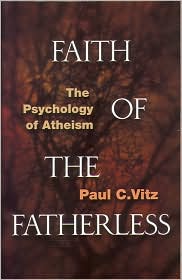
Anyway, the main topic for the class last night was "The Existence of God." We covered a wide range of proofs and arguments, but one of the questions that came up was how atheists become atheists. I recalled a book I read not long ago called "Faith of the Fatherless: The Psychology of Atheism." Here is the Amazon.com link and their product description:

Starting with Freud's "projection theory" of religion-that belief in God is merely a product of man's desire for security-Professor Vitz argues that psychoanalysis actually provides a more satisfying explanation for atheism. Disappointment in one's earthly father, whether through death, absence, or mistreatment, frequently leads to a rejection of God. A biographical survey of influential atheists of the past four centuries shows that this "defective father hypothesis" provides a consistent explanation of the "intense atheism" of these thinkers. A survey of the leading intellectual defenders of Christianity over the same period confirms the hypothesis, finding few defective fathers. Professor Vitz concludes with an intriguing comparison of male and female atheists and a consideration of other psychological factors that can contribute to atheism.

Professor Vitz does not argue that atheism is psychologically determined. Each man, whatever his experiences, ultimately chooses to accept God or reject him. Yet the cavalier attribution of religious faith to irrational, psychological needs is so prevalent that an exposition of the psychological factors predisposing one to atheism is necessary.

There is also a free downloadable mp3 talk by Professor Vitz on this topic found here:

Professor Vitz examines the lives of several notorious atheists --Voltaire, Friedrich Nietzsche, Betrand Russell, etc -- as well as what he calls "political atheists" ---like Hitler, Marx, and Stalin --and points to the common denominator of a dysfunctional or deficient image of fatherhood in particular and manhood in general in their formative years. Especially interesting was the account of atheist Madalyn Murray O'Hair (the one who successfully sued to take prayer out of public schools) who once publicly tried to kill her own father with a butcher knife and screamed at him "I'll live to dance on your grave!"

As a corrollary to this, I think there is good evidence that, even among believers, one's image of God as a fatherly image is greatly affected by how one percieves (or perceived) their earthly father. If one had an abusive or distant father, it is hard to relate to God as caring and loving. If one's father was there but not involved, it makes it that much harder to grow closer to God, our Father in heaven. This can be overcome, of course, by prayer and by growing in knowledge and trust of God over time, but it is still something a lot of folks have to overcome.

Bottom line: If you are a father or serve as a fatherly role model in some capacity, do not under-value or under-estimate your presence and example in your child's or other young person's developing image of God. Happy Father's Day!

Thursday, June 11, 2009

Get the Facts: Free mp3 Download about "Angels & Demons"

Just another badly written book? Don't be duped -- this latest laugher (unintentionally) by Dan Brown (and now the movie) targets the Catholic Church directly. And it does so with lies, innuendo, slander and eye-rollingly bad "research" and "facts."

Praise God there is an audio presentation by Matthew Arnold from Lighthouse Catholic Media that sets the record straight. And the best thing is that it is FREE! Share this with everyone you know that has read the book or saw the movie AND is gullible or uninformed enough to buy any of the baloney being sold by Brown, Opie, or Woody.

Find it here: